
Other Minnesota DOC Release Paths
There is no single “Blue Earth state prison.” A Blue Earth County District Court can commit a person to the Commissioner of Corrections, and Minnesota DOC selects placement within its statewide system. The prison may be far from the county of conviction. The release county, supervision location, and correctional facility can also differ from Blue Earth County.
A person leaving a Minnesota prison usually enters supervised release or another authorized community placement. Supervised release is the community portion of a prison sentence, with conditions and a supervising agent. It is not the same as probation imposed by the district court. The person is out of prison but remains under DOC jurisdiction until sentence expiration or discharge. Some board-eligible cases follow a separate review path.
Transfer among DOC prisons does not count as release. Movement from Blue Earth County Jail to DOC is also a transfer into state custody. Confirm the sheriff's transfer entry and the court commitment, then use the statewide corrections record. The county roster is not the correct locator once DOC takes custody.
| Status point | Correct meaning |
|---|---|
| In a DOC prison | Confined under Minnesota DOC jurisdiction. |
| Released under supervision | Out of prison, but still serving the community portion of the sentence. |
| Fugitive or absconder status | An alleged supervision violation and evasion issue, not a county booking history. |
| Expired or discharged | DOC jurisdiction ended, subject to the exact record and any other custody system. |
Search Minnesota DOC Facility Releases
The Minnesota DOC Public Viewer is the online starting point for adults committed to the corrections commissioner who remain under DOC jurisdiction. DOC explains that its scope includes people in prison and people released from prison who are still under supervision. It does not cover someone whose custody consisted only of Blue Earth County Jail or local probation.
- Search with the Minnesota DOC identification number when available. It is more precise than a name alone.
- For a name search, use the legal spelling and verified variants. Compare public identifiers before selecting a record.
- Open the matching detail and preserve the exact status or location, offense and sentence data, supervision information, and controlling dates.
- Read the record as of its displayed access time. Do not rewrite a field label into a different release term.
- If no record appears, check spelling and custody type, then use the DOC records-request path rather than declaring discharge.
The search entry fields are visible in the official DOC Public Viewer.
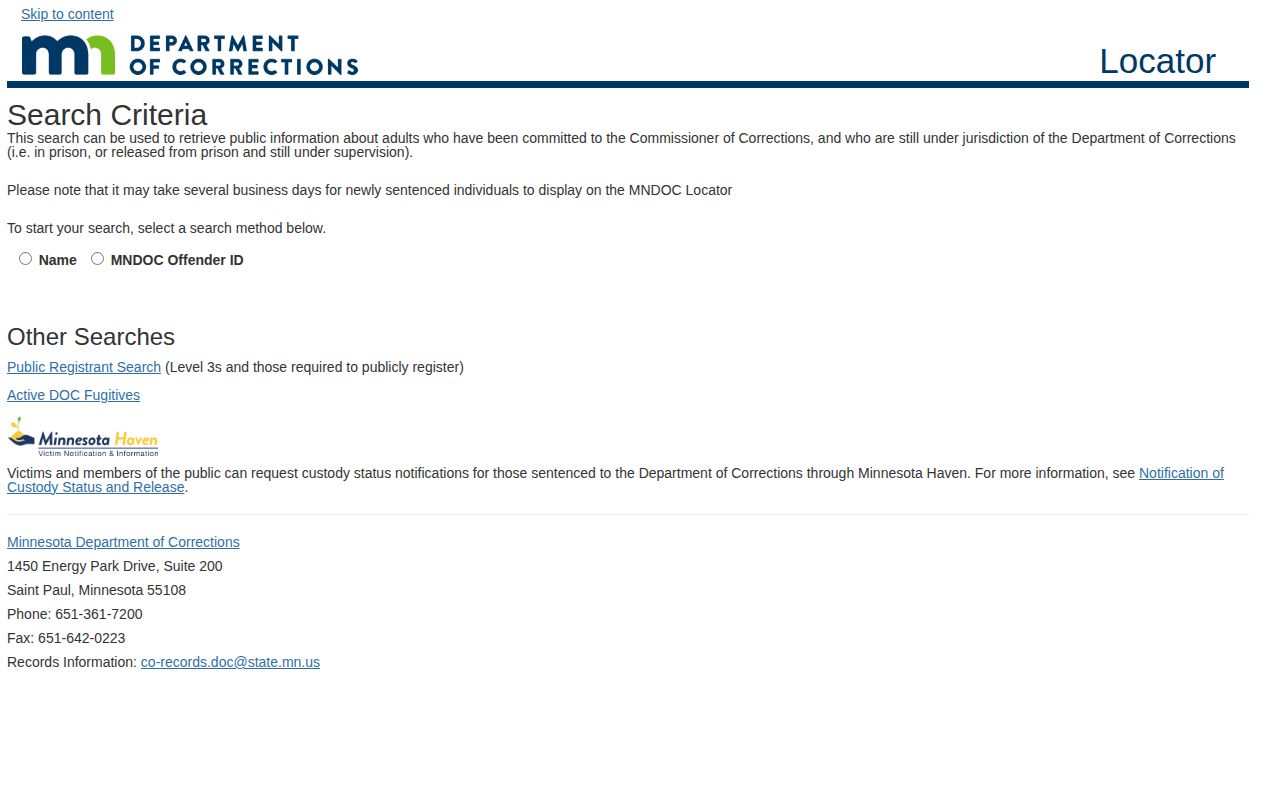
The captured landing screen documents the statewide search channel without displaying or fabricating a person-specific result.
Minnesota DOC Release Viewer Fields
A returned DOC detail can include identifying information, a Minnesota DOC number, photograph, status or location, offense and sentence data, and controlling or projected dates. Exact labels and availability vary by person and system version. Preserve what the screen actually says. A community location or supervision field can establish that prison confinement ended even though DOC authority continues.
The live Public Viewer is not a full historical discharge archive. DOC defines its scope by continuing jurisdiction. A person who completed supervision may no longer appear. Someone sentenced only to county jail or probation may never have been included. A no-result screen can also reflect spelling differences, data limits, or another custody system.
| Viewer information | How to interpret it |
|---|---|
| DOC identification number | The best key for matching records and later requests. |
| Current status or location | Distinguishes prison confinement from a community status when clearly labeled. |
| Offense and sentence | Connects the DOC record with the court commitment. |
| Supervision information | Shows continuing DOC jurisdiction after prison release when available. |
| Controlling or projected date | A labeled planning or sentence date, not automatic proof of completed release. |
Compare identity carefully. A similar name is not enough to attribute a Minnesota prison history. Use the DOC number, date of birth or other public identifiers, offense, and Blue Earth County case before drawing a conclusion.
Minnesota Prison Release Sentence Framework
For covered fixed felony sentences involving offenses committed on or after August 1, 1993, Minnesota Statutes section 244.101 divides the executed sentence into a two-thirds imprisonment term and a one-third maximum supervised-release term, subject to section 244.05. Minnesota does not use a simple 85-percent rule here. The community portion remains part of the sentence.
Current earned incentive provisions add another layer for eligible people. Section 244.44 permits credit up to 17 percent of the total executed sentence, prevents reduction below one-half of the executed sentence, leaves the total supervised-release term unchanged, and makes credit revocable. Eligibility, offense date, exclusions, discipline, consecutive sentences, mandatory minimums, and conditional-release terms all matter.
Release dates can also change because of disciplinary confinement, a new sentence, detainer, failure of a release plan, or later board action. Life, indeterminate, and specified cases may receive review from the Minnesota Supervised Release Board. Most Minnesota releases do not depend on a general parole hearing, so absence from a board calendar proves nothing about an ordinary determinate sentence.
For closer date interpretation, the Blue Earth County Inmate Release Date resource separates county projected fields from DOC controlling dates.
Note: A projected date is subject to the sentence and release process; only the later status and record can confirm what occurred.
Minnesota DOC Release Records Fallback
When the Public Viewer returns no result or no longer covers a fully discharged person, use the Minnesota DOC offender-record request. Identify the DOC number, full name, and the narrow record sought. Useful requests name the release or supervised-release date, status history, controlling dates, sentence expiration or discharge entry, and any public board decision tied to the person.
A Public Viewer printout is convenient evidence of what the live system displayed. It is not a certified historical record. DOC Records Management is the better source for an older release, final discharge, or a public written board decision that is not searchable online. The research records telephone 651-361-7330 and email CO-Records.DOC@state.mn.us for historical record routing.
Minnesota DOC's government-data form permits inspection, copies, both, or summary data. Inspection of public data is free. The form states that copies may cost $0.25 per page or authorized actual retrieval, copying, and delivery costs, with payment before production. Ask for an estimate and keep the request focused.
Older or absent online data should not be treated as proof that no prison release occurred. A court record can verify the sentence and commitment, while DOC supplies the confinement, supervised-release, expiration, and discharge history.
Minnesota Haven Prison Release Notices
Minnesota uses two notification layers. Minnesota Haven and DOC Victim Assistance cover state-prison custody and release notices. Minnesota VINE covers county-jail notifications. Registering only with VINE can leave a person watching the wrong system after a Blue Earth County Jail transfer to DOC.
The DOC notification path can provide notice of prison release, agent assignment, and sentence expiration for eligible registrants and events. The published contact is 1-800-657-3830 and victimassistance.doc@state.mn.us. A notification should be preserved with its exact event wording and time. It supports the release inquiry but does not replace the offender record.
- Minnesota VINE
- County-jail custody and release notification, including Blue Earth County Jail.
- Minnesota Haven
- Minnesota DOC prison-release and related corrections notification.
- DOC discharge
- The later end of corrections jurisdiction, not merely the date a person leaves prison.
Blue Earth DOC Transfer Evidence
A person can disappear from the Blue Earth County Jail roster because DOC took custody after a court commitment. That is not release to the community. Ask the Sheriff's Records Division for the permanent jail entry showing the transfer date, authority, and receiving agency. Compare it with the Blue Earth County criminal case and the matching DOC record.
The receiving prison should not be guessed from geography. Minnesota DOC can choose any suitable placement and move a person within its system. MCF-Faribault and MCF-Shakopee are two specific facilities that can serve people from Blue Earth County cases, but “Other Minnesota DOC Facilities” covers the remaining statewide placements and authorized release settings.
Once the DOC record shows a community or supervised status, prison confinement may have ended. DOC jurisdiction has not necessarily ended. A final discharge or sentence-expiration entry is the later milestone. The DOC search-scope explanation expressly includes people released from prison who remain under supervision.
Minnesota DOC Contact and Scope
Minnesota DOC administers the statewide prison and supervised-release system. It is not a Blue Earth County jail office. The headquarters contact supports agency routing, while records requests and the Public Viewer have their own channels.
| System | Other Minnesota DOC Facilities |
|---|---|
| Operator | Minnesota Department of Corrections |
| Headquarters | 1450 Energy Park Drive, St. Paul, MN 55108 |
| Main telephone | 651-361-7200 |
| Public search | Statewide DOC Public Viewer |
| Historical records | DOC Records Management request channel |
| Prison notification | Minnesota Haven and DOC Victim Assistance |
County-jail questions remain with the Blue Earth County Sheriff. Federal prison releases use BOP, immigration detention uses ICE, and U.S. Marshals pretrial custody has no general public locator. The Blue Earth County released inmate search path helps identify the correct system when the receiving authority is uncertain.